Four products, one payment each: $10 · $29 · $99 · $299
AI is the intern.You are always the attending.
A safety-first documentation system for clinicians using general-purpose AI. Which tasks to point it at, and what may never go into it. Then how to check a draft before you sign.
One payment. No subscription. Twelve months of updates included, and the files stay yours.
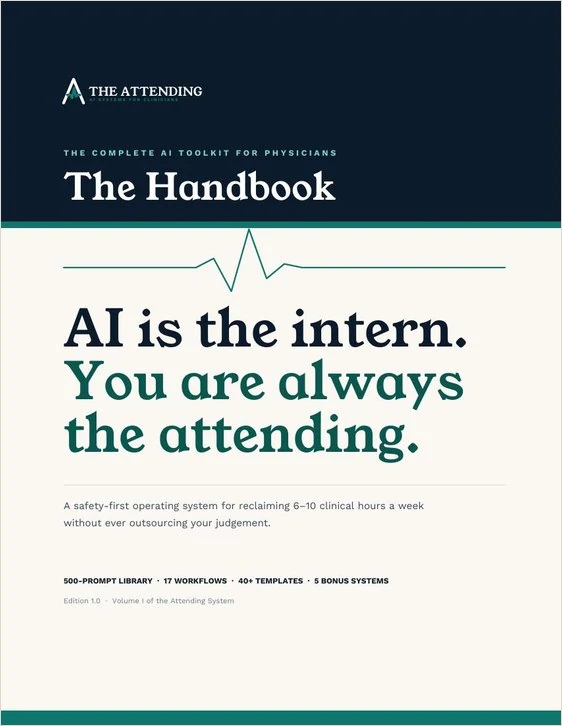
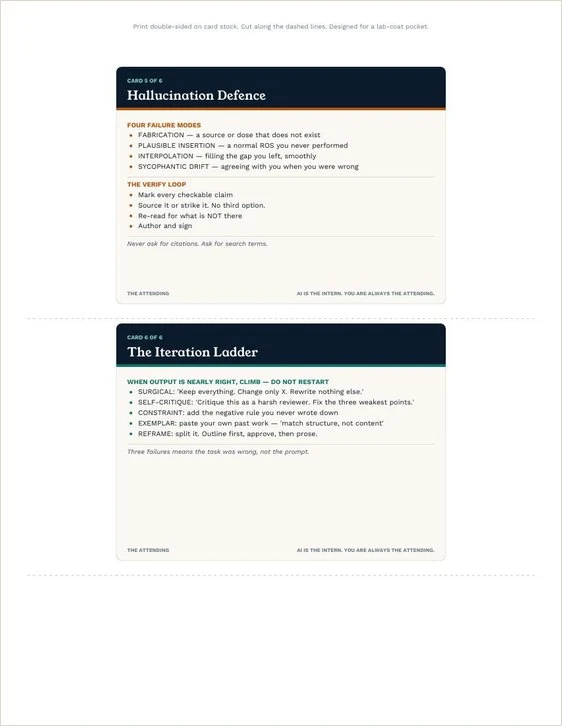
Rendered from the files you download
What it produces
The part most AI demos leave out
Most tools show a finished note. Mine shows where the model was stopped from filling in a blank.
"ok 62 year old guy back again three days of cough worse at night no fever he thinks, ex-smoker quit maybe 2015, chest sounds ok to me, sats were fine, started him on the inhaler, review a week, told him red flags"
S: 62 y/o male, re-presentation. 3 days productive cough, worse nocturnally. Subjectively afebrile. Ex-smoker, ceased approx. 2015. O: Chest auscultation: [NOT DOCUMENTED] Oxygen saturation: [VALUE] Temperature: [NOT DOCUMENTED] A: [CLINICIAN IMPRESSION] P: Inhaler commenced, [AGENT, DOSE] Review in 1 week. Red-flag safety-netting given.
Why it works this way is written down. The four-box triage, the Second Signature Rule, how it coexists with ambient scribes, and what this deliberately is not.
Read the method →What you download
30 files, photographed below.
No "and much more." The manifest ships inside the download as a packing slip you can check off, file by file. These images are rendered straight from the shipped PDFs.
The Handbook
45 pages: the safety architecture, the four-box method, the nine red lines, the three-tier PHI firewall, and seven end-to-end workflows. Plus a 4-page addendum, When NOT To Use This.
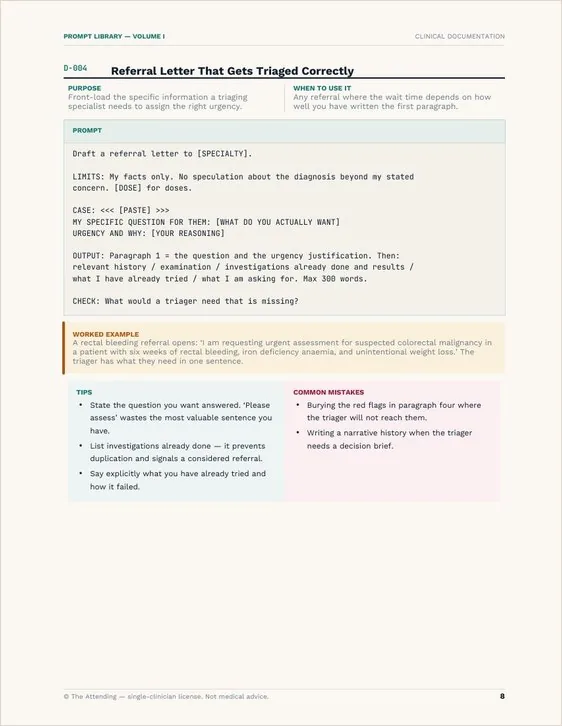
The prompt library
Twelve clinical-administrative categories, every prompt badged: Green 58 use as written, Amber 42 verify against source first. 123 pages as PDF, plus the identical library as markdown for pasting.
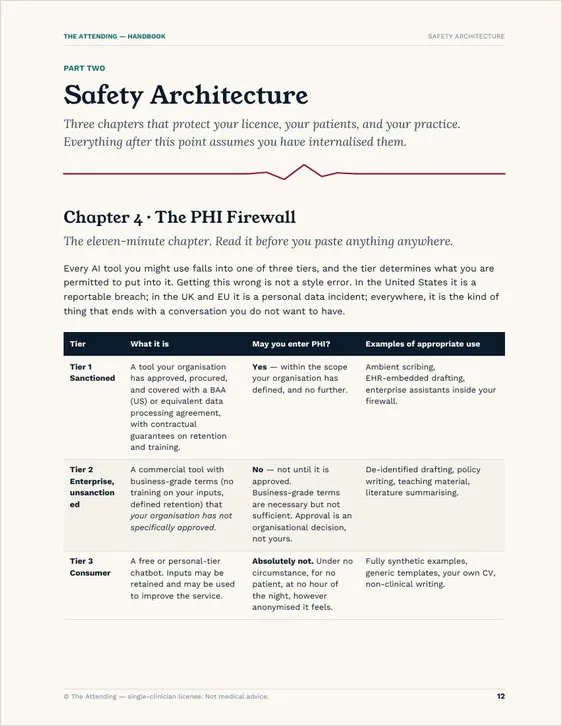
Workflows, end to end
Each one walks from raw input to signed output, with the verification step built in. Four of the seven use no patient data at all, which is where most people should start.
Pocket references
Pre-send verification, the PHI firewall pocket card, the red-lines card, the attestation checklist, the thirty-day rollout sequence, and the 18-identifier Safe Harbor checklist with the mosaic-risk test.
Bonus systems
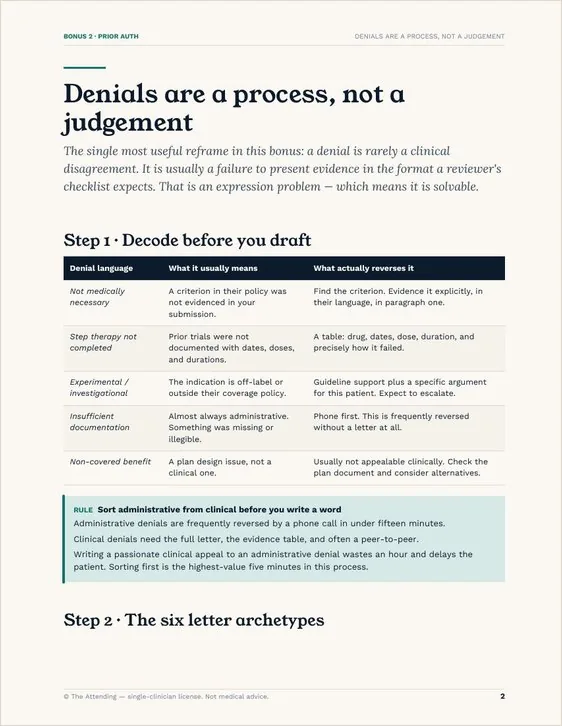
The Ninety-Minute Inbox (fifty replies into six reusable structures), the Medical Necessity Kit, and the Teaching Kit.
- 8 EHR phrases, plain .txt
- 4 Word template packs
- 3 Excel tools, incl. Time Recovery Audit
- 1 Start Here page
Phrases, packs, trackers
Note skeletons with visible wildcard stops, written in Epic dialect. They go into Cerner AutoText, athena and eCW macros too, with a trivial change to the trigger syntax. One ZIP, numbered folders, PDF, Word, Excel, markdown and plain text.
Every number on this page is generated from the files you download. Counts were verified file by file against the archive. Want proof before paying anything? The Safe Harbor de-identifier and The Attending Standard are free and need no account.
Before you buy
What it deliberately is not
The full list, and the evidence position stated plainly, is on the method page.
Pricing
One payment, no subscription.
The AI scribes I graded charge $39 to $104 a month each, by their own pricing pages, read 12 September 2026. This is a one-time purchase with twelve months of updates, and the files are yours to keep permanently, including if you refund.
Hospital Pocket Notes
For residents, hospitalists and anyone covering adult inpatients. Sized for a phone.
One-time · edition 1, every later edition free · 30-day refund, keep the file
- Nine chapters: sepsis, pneumonia, AF with RVR, hyperkalemia, hyponatremia, DKA and HHS, COPD, asthma, inpatient pain and opioid safety
- A source tag on every number, from the named published guideline
- Where the guideline is silent, the page says so instead of guessing
- Three files, instant download: the A5 PDF at 81 pages, a phone edition of the same nine chapters rebuilt at 209 short screens, and note-lines.txt, every chart line in plain text
- Reviewed and signed off chapter by chapter by a practicing physician of thirteen years
- For licensed clinicians only. A summary of named guidelines, not medical advice and not a decision tool. Verify every dose against the current label and your pharmacist
Full description of the three files →
Get Pocket Notes, $29Visa · Mastercard · Amex · Apple Pay · Google Pay · PayPal
Clinician Suite
For an individual clinician, attending, resident, locum, PA or NP.
One-time · 12 months of updates · 30-day refund, keep the files
- All 30 files, complete
- The Safe Harbor de-identifier, the full build: surrogates, review mode, linkage key
- Handbook, 100 badged prompts, 8 EHR phrases, each with its own conversion block for Cerner, athena, eCW and Meditech
- 4 Word packs · 3 Excel tools · checklists & cards
- 3 bonus systems (Inbox, Medical Necessity, Teaching)
- Every number sourced or labelled: four studies by DOI and PubMed ID, the rest named as ours
- Instant download, delivered in under a minute
- Personal license, unlimited personal clinical use
Full description of the 30 files →
Get the Clinician Suite, $99Visa · Mastercard · Amex · Apple Pay · Google Pay · PayPal
Note Phrases
For hospital and clinic notes. Pastes into any EHR phrase library.
One-time · every later edition free · 30-day refund, keep the files
- 68 documentation phrases for hospital and clinic notes
- Plain text plus PDF, pastes into any EHR phrase library
- No diagnosis, no treatment, no drug, no dose
- Twelve are free
Read twelve of the phrases free →
Get Note Phrases, $10Visa · Mastercard · Amex · Apple Pay · Google Pay · PayPal
Practice Suite
For a practice: ten seats of the Clinician Suite plus the governance layer it does not contain.
One-time · ten seats · 12 months of updates · 30-day refund while fewer than ten seats are distributed
- Ten seats of the Clinician Suite
- The Practice AI Governance Pack, 11 files: an editable AI-use policy, an SOP template, a governance register
- Seats are named but reassignable
- An ROI calculator with its assumptions sourced to published studies
- Invoice on request; Gumroad, Inc. is the merchant of record
Full description of the Practice Suite → · Need more than 10 seats? Ask about enterprise
Get the Practice Suite, $299Visa · Mastercard · Amex · Apple Pay · Google Pay · PayPal
Thirty days. No questions. Keep the files.
Checkout is temporarily unreachable
The store runs on Gumroad and every purchase is completed there. If this button did not take you to it, the link is misconfigured on my side. Please try again shortly, or write to support@theattending.net and I will send you the correct store link. All purchases are completed on Gumroad.
In the meantime everything you need to judge the product is already free and needs no account: the standard and the de-identification tool.
Why $99 today, and what makes it go up
Buy at $99 and every update inside those twelve months arrives free, including the modules above. I am not running a countdown clock. The price moves when the work ships.
Reviews
Reviews from readers
Free or paid, written by the reader and published unedited after a quick look by us.
The review box opened in September 2026. What readers write appears here unedited, so the first one you read will be a real one.
Leave a review
Thank you.Your review is with us and goes up after a quick look.
Questions
The ones that decide it
Is this safe to use with patient data?
Chapter 4 is the honest answer, and it is longer than you want it to be. The short version: the package uses a three-tier tool classification, a de-identification protocol, and a mosaic-risk test for whether "de-identified" actually is.
Nothing you buy makes an AI tool compliant. If your organization has not approved a tool covered by a BAA or equivalent data-processing agreement, the answer for identifiable data is no. And this package says so in those words. Four of the seven workflows use no patient data at all, which is where most people should start.
How is this different from an ambient scribe?
A scribe listens to an encounter and writes that encounter's note. This covers everything a scribe has never touched: prior-authorization appeals, AMA discharges, critical-care time attestations, handoffs, complaint responses, referral letters, patient handouts at controlled reading levels, teaching material, and practice policy.
These coexist with a scribe, and cover the rest if you never get one.
I'm on Cerner / athena / eClinicalWorks / a custom EHR. Is this Epic-only?
No. The phrases were written in Epic dialect because that is where they were built, but they
ship as plain .txt with visible wildcard stops, which is the most portable format in
this category. They go into Cerner AutoText, athena and eCW macros, or any text-expansion tool,
with a trivial change to the trigger syntax.
Everything else, letters, appeals, handouts, policies, the inbox system: is EHR-agnostic, because appeals and handouts live in Word and fax-land regardless of what your hospital bought.
Who reviewed it? Has it been peer reviewed?
Nobody has, and I am not going to pretend otherwise. This has not been through external peer review. I wrote it as one practicing clinician of thirteen years and stress-tested it against a catalog of forty-seven documented failure modes, published free so you can audit the reasoning yourself rather than trust a number of anonymous reviewers.
I am keeping it that way, because a product whose whole thesis is "verify before you sign" has no business asking you to take its own credentials on faith. The refund policy is the trial: thirty days, no questions, keep the files.
What is the refund policy, precisely?
Thirty days, no questions, and you keep the files. I am not going to argue with a physician over a $99 purchase, and I cannot un-give you a download, so I do not pretend otherwise. Refunds are processed within three business days.
Email me before your bank. I will resolve it faster than a chargeback will. Full terms on the refund page.
Start with one workflow.
Just one. Open the orientation page and pick the workflow for the task you dread most. Run it tonight. If nothing changes in thirty days, take your money back and keep everything.
After payment Gumroad sends the download link within a minute. Open the Handbook first. Thirty day refund, keep the files; details on the refund page.
One payment · No subscription · 30-day refund, keep the files · Instant download
Not ready to buy?
Get the free protocols first.
The Attending Standard, six named safety protocols, is published free and needs no email. Join the list and you get one email when the measured time study publishes, with its method attached and its N stated. That is the whole list.
I never ask for and never want patient information. Unsubscribe in one click, in every email. Full detail in the privacy notice.