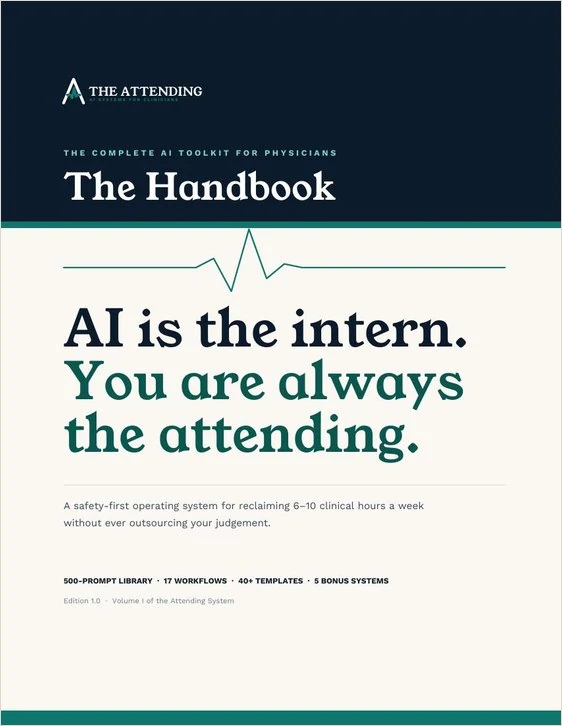
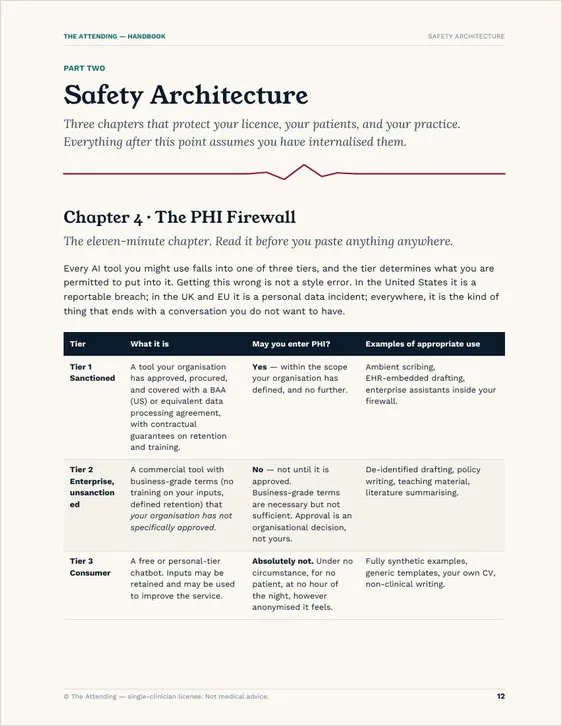
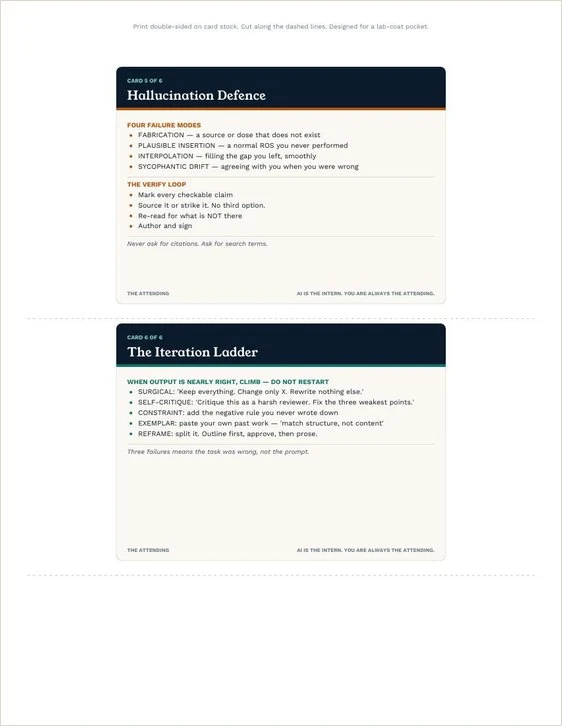
From the toolkit that implements the standard: the handbook, its safety chapters, and the printable lab coat cards.
The six protocols
Each one is a rule you can adopt today without any file from us. The paid toolkit is the
implementation manual; the standard itself is free.
01
The Second Signature Rule
No AI-generated content enters a record, reaches a patient, or goes to a payer until a licensed clinician has read every word and taken responsibility for it. Not skimmed. Read.
02
The Four Boxes
Before anything is typed, the task goes in exactly one box. DON'T, diagnosis, treatment, consent, capacity. DOUBLE-CHECK, coding, guidelines, anything with a number. DRAFT, notes, letters, appeals. DELEGATE, reformatting, reading level, admin.
03
The PHI Firewall
A three-tier classification of tools by the data they may receive, a de-identification protocol, and the mosaic test, because a rare diagnosis in a small town identifies someone no matter how many fields you strip.
04
The CHECK Block
Every prompt ends by forcing the model to list what it added that you did not supply. You are not asking it to be honest. You are requiring a diff. Trust is not a prompt technique.
05
The Attending Risk Level
Every task carries one of three marks. GREEN use as written · AMBER verify the output against source before it goes anywhere · RED never delegate this. A library without triage is a pile.
06
The Ninety-Second Audit
Five checks between the draft and your signature: did it invent a finding · did it invent a number · did it harden a hedge into certainty · does every wildcard have real content · would this read the same for the next patient. If yes to the last one, it is a cloned note.
Read this before you use any of it. The Attending Standard is educational material for
qualified clinicians. It is not a medical device, not clinical decision support, and not a source of
medical or legal advice. It does not diagnose and does not recommend treatment. Nothing here
makes any AI tool HIPAA- or GDPR-compliant. Your organization's approved-tool policy, your
regulator's guidance and your own professional judgment take precedence over every word on this page.
Free tools
Use everything here free. The pocket card is the one thing on this page that asks for an email, because we send it to you. The two boxes further down are optional and separate: one tells you once when a tool goes live, the other sends corrected editions. We would rather you used these and never bought anything than guessed.
Live now
Safe Harbor De-identifier
Paste clinical text; it scans for the 18 HIPAA Safe Harbor identifiers and masks what a pattern can catch, before you put anything into an AI tool. Runs entirely inside your browser. The page is served with a Content-Security-Policy that makes an outbound request impossible, not merely absent. Disconnect from the network and it still works.
Twelve of the sixty eight phrases from Note Phrases: code status, capacity, refusal, critical result, IPASS handoff, universal protocol time out, discharge pending results, discharge instructions, a negative review of systems, an event disclosure, a curbside opinion, and a signout. Plain text, pastes into any EHR phrase library. Documentation language only: no diagnosis, no treatment, no drug. The full set of 68 is $10.
Four scribes so far, twenty four notes, one method: what each note invented, what it dropped, and whether the doses survived. Prices from the vendors' own pages. No referral links, no email.
Forty seven ways an AI draft goes wrong in a chart, each with what it looks like, why it happens, a check that fits before a signature, and the rule that prevents it. Read on the page or download the PDF. No email.
The eighteen identifiers and the five-step protocol on one page, marked for which ones a tool can find and which ones only you can. Print it and pin it above the workstation. One page. Free. We ask for your email so we can send it to you.
One email, and only when there is one
Tell me when the study publishes
Everything above is already yours, no email needed. This list exists for one thing: the measured
study result, with its method attached and its N stated, however unflattering the number turns out
to be. That is the whole list. No drip sequence, no funnel, and no second email between now and then.
We never ask for and never want patient information. Unsubscribe in one click, in every email.
Full detail in the privacy notice.
What I carry on shift
The standard above is free forever. Written down alongside it: Hospital Pocket Notes, nine
chapters summarizing named published guidelines, a source tag on every number, $29 one time. One
chapter is free and complete, no email. Thirty day refund, keep the files.
After payment, Gumroad sends the download link within a minute.Thirty day refund, no questions, keep the files.Questions: support@theattending.netYour review, free or paid, goes live after a quick look: Write a review
Reviews
Reviews from readers
Free or paid, written by the reader and published unedited after a quick look by us.
No reviews yet. Yours would be the first.
Leave a review
Thank you.Your review is with us and goes up after a quick look.